A certificate of analysis is the manufacturer's statement. An independent test is someone else's measurement. The second is more valuable than the first only when it is done properly: a sample you chose, sent under your control, to a laboratory with no interest in the result, with a test panel that answers your actual question, producing a report you can confirm on the laboratory's own website. Done badly, independent testing produces a document with a logo on it that proves nothing more than the certificate did.
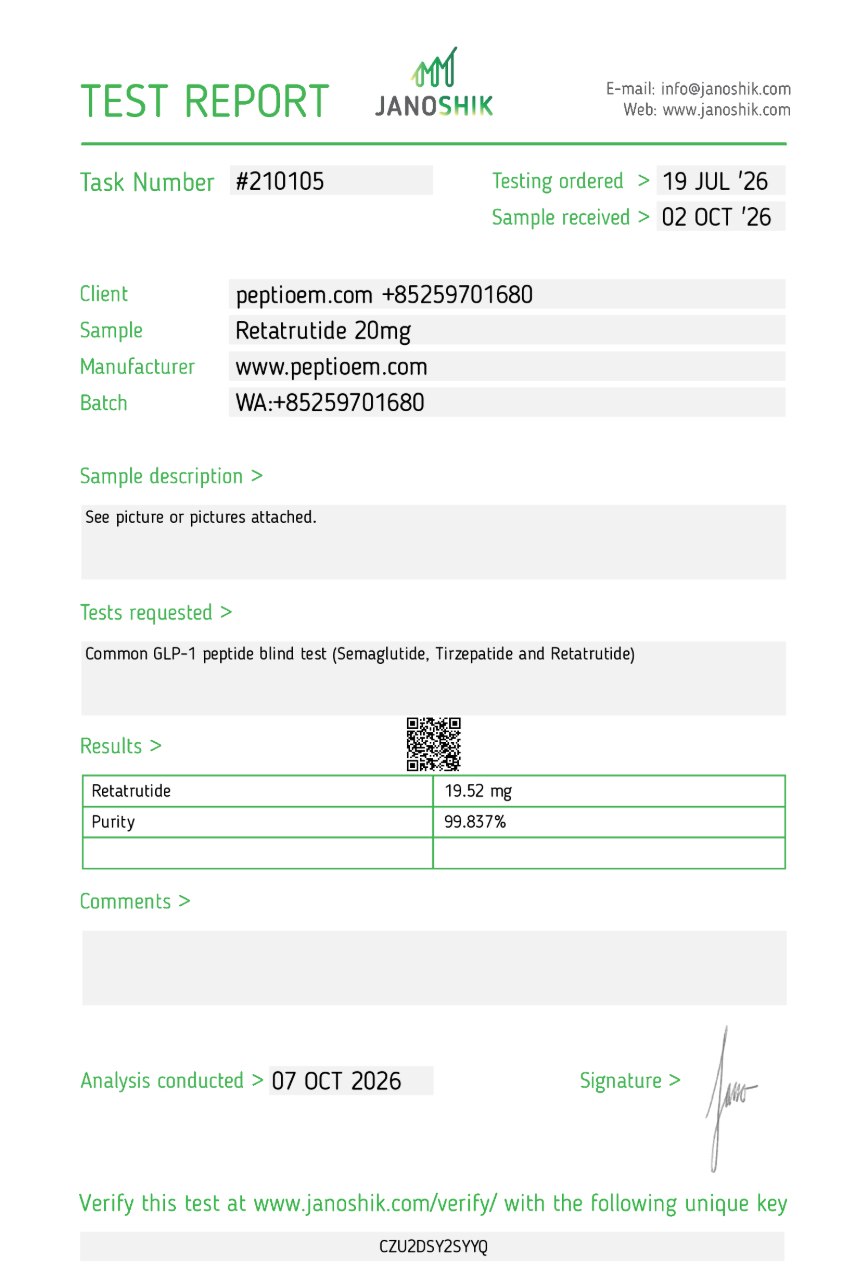
This guide covers the arrangement, from choosing a laboratory to agreeing in advance what the result will mean, and then reads one real report line by line: Janoshik Analytical task 210105, a Retatrutide 20 mg sample submitted by Pepti, the manufacturer that maintains this site. That report is useful as a teaching example partly because of what it shows and partly because of what its batch field does not show, which is the single most common mistake in sample submission.
What independent testing can and cannot establish
Independent testing answers a narrow question well: what is in this sample? Within the limits of the method, a competent laboratory will tell you the identity of the main component, its chromatographic purity, and, if asked, how much of it the vial contains. That is powerful because it does not depend on anyone's say-so.
What it cannot do is generalize. One report describes one sample. It does not describe:
- other vials from the same lot, unless sampling was designed to represent the lot;
- other lots, strengths or products from the same supplier;
- the supplier's consistency over time;
- anything about a vial whose chain of custody is unknown.
The last point is the one that matters most and is most often ignored. A report on a sample the vendor selected and sent to the laboratory is evidence about that sample; it is not evidence about what the vendor ships to customers. A report on a sample you took from a parcel you received is evidence about what you were sent. The two are different in kind, and the registry on this site records, for each entry, who submitted the sample for exactly that reason.
Independent testing is also only as good as the laboratory's methods, and a laboratory that does not state its methods, is not accredited for them, or cannot be reached is not providing independence so much as a second opinion of unknown quality.
When to test
Four occasions justify the effort and cost:
- A first order from a new supplier, once the supplier has passed the legitimacy checks and its certificate reads correctly. Testing a small first order converts the supplier's claims into a measurement before you commit to volume.
- Before scaling up, when a trial quantity becomes a standing order. The sample should come from the lot you will actually receive, or the supplier should state in writing that the tested lot is the one that will ship.
- Periodically, on a standing supply, to check lot-to-lot consistency; comparing a new lot's chromatogram with earlier ones is more informative than any single purity figure.
- On dispute, when a result or an observation does not match the certificate. Here the laboratory, the method and the acceptance criteria should be agreed with the supplier before the sample is sent, or the result will settle nothing.
Testing every order from an established supplier is usually unnecessary; testing none from a new one is usually unwise.
Choosing a laboratory
The criteria, in order of importance:
Independence. The laboratory should have no commercial relationship with the supplier beyond, at most, having received samples from them. Laboratories that are owned by, resell for, or are promoted by a vendor are not independent for that vendor's products. Ask.
Methods. For peptides, the core panel is identity by mass spectrometry and purity by reversed-phase HPLC with UV detection; content (quantity per vial) requires a calibrated method against a standard. A laboratory should be able to tell you its methods in enough detail to compare with the supplier's (column, gradient, wavelength, instrument), and should state them on the report.
Verifiability of reports. The report should carry a code or link that retrieves the same report from the laboratory's own website, so that a reader who was not party to the test can confirm it exists and has not been altered. This is the inclusion criterion for the registry on this site, and the reason: a report that lives only as a PDF in someone's inbox can be edited; a report that resolves at the laboratory cannot, at least not by the party showing it to you.
Accreditation and scope. Accreditation to ISO/IEC 17025 is the recognized standard of laboratory competence and is granted by national accreditation bodies for a specific scope of tests. If a laboratory claims it, confirm it in the accreditation body's directory (A2LA in the United States, CNAS in China, UKAS in the United Kingdom; the ILAC signatory list leads to the rest) and read the scope: accreditation for one kind of test does not extend to others. Many laboratories that serve the research-peptide market are not accredited; that is not disqualifying if the methods are sound and the reports verifiable, but it is a fact to weigh and to record.
Turnaround and communication. A laboratory that answers questions about its methods before you submit will answer questions about its results afterwards.
Cost varies by laboratory and panel and is not discussed here; it is rarely the deciding factor once the sample and the question are well defined.
Chain of custody
The value of the test is decided before the laboratory ever sees the sample. The steps:
- Select the sample yourself, from the parcel you received, at random among the vials of the lot. Do not accept a vial the supplier sends "for testing" as a substitute for this unless the purpose is to evaluate the laboratory rather than the supplier.
- Photograph the vial with its label, lot code and any QR code legible, alongside the outer packaging and the shipping label, before opening anything. The photographs tie the sample to the shipment.
- Record the identifiers: supplier, product, labeled strength, lot code, date received, your own sample reference.
- Seal and ship the unopened vial, or, if the laboratory requires it, the vial in its original closure, using a tracked service. Keep the tracking record.
- Fill in the submission form completely. This is where most reports lose their value. The laboratory will print on the report whatever you tell it about the sample. Put the manufacturer's lot code in the batch field. Put the supplier or manufacturer's name in the manufacturer field. If you wish the test to be blind as to source, say so to the laboratory and understand that the report will then not tie to the lot.
- Keep a retained vial from the same lot, unopened, in case a retest or a dispute needs a second sample.
Regulated manufacturing codifies this in rules about representative sampling and sample identification (21 CFR 211.84 and 211.160 are the US provisions); a buyer does not need the regulation, but the logic is the same. A sample whose origin cannot be documented cannot support a conclusion about anything but itself.
Specifying the test panel
Tell the laboratory what question you are asking; it will choose methods accordingly. The usual building blocks:
- Identity by mass spectrometry: is the main component the named peptide? Ask for the observed mass and the convention (monoisotopic or average; neutral or protonated); see the HPLC and MS guide.
- Chromatographic purity by HPLC-UV: what fraction of the detected material is the main peak? Ask for the chromatogram, the method and the integration threshold.
- Content (quantity): how many milligrams of peptide are in the vial? This requires a calibrated method and, ideally, a reference standard; ask how it was done. Content is the figure that tells you whether a "20 mg" vial contains 20 mg of peptide.
- Impurity profile: individual peaks above a threshold, with masses if LC-MS is used. Useful for comparing lots.
- Water and counter-ion: rarely requested; relevant when you need the mass balance.
- Microbiological tests and bacterial endotoxin: offered by some laboratories; relevant to particular document sets and not to the chemical question of what the peptide is.
A panel of identity, purity and content answers the questions most buyers actually have. Agree in advance what result you will treat as acceptable (for example: identity confirmed; purity within a stated margin of the certificate; content within a stated percentage of label) so that the report leads to a decision rather than a debate.
Reading a Janoshik report: task 210105
Janoshik Analytical is a laboratory widely used in the research-peptide market whose reports carry a task number and a verification key. The report below was commissioned by Pepti on a Retatrutide 20 mg sample; the image is published on Pepti's site and the fields are transcribed here. Read it with the method above in mind.
| Field on the report | Entry | What it tells a reader |
|---|---|---|
| Task number | 210105 | The laboratory's reference; used with the key to retrieve the record |
| Testing ordered | 19 July 2026 | When the request was placed |
| Sample received | 2 October 2026 | When the sample arrived; a long gap between order and receipt is itself information about logistics, not quality |
| Client | peptioem.com (with a contact handle) | Who commissioned the test: here, the manufacturer |
| Sample | Retatrutide 20 mg | Product and labeled strength |
| Manufacturer | www.peptioem.com | Who the client states made it |
| Batch | a contact handle, not a lot code | See below |
| Sample description | "See picture or pictures attached" | The laboratory photographed the sample; the images accompany the record |
| Tests requested | Common GLP-1 peptide blind test (semaglutide, tirzepatide and retatrutide) | A panel that identifies which of three related peptides is present and quantifies it |
| Results | Retatrutide 19.52 mg; Purity 99.837% | The two figures most readers want |
| Analysis conducted | 7 October 2026 | The test date |
| Verification | janoshik.com/verify with key CZU2DSY2SYYQ | How to retrieve the record from the laboratory |
What the results mean. The laboratory found the main component to be retatrutide, not one of the two related peptides in the blind panel, at 19.52 mg per vial against a labeled 20 mg, which is 97.6% of label. Chromatographic purity was 99.837%, consistent with the 98.4–99.8% range across the manufacturer's public lot records. For a single sample, those are good results.
What the report does not establish. Three things, and the report itself makes all three visible if you read the fields rather than the numbers.
First, the sample was submitted by the manufacturer. The client field says so. This report therefore demonstrates what the manufacturer chose to send and what the laboratory found in it; it is not a buyer-selected sample from a delivered parcel. Pepti's own site describes it in the same terms, as sample-specific evidence and not a claim about every lot, and that is the right description.
Second, the batch field does not carry a lot code. It carries a contact handle. Whoever completed the submission form entered a messaging contact where the manufacturer's lot identifier should have gone. The consequence is that the report cannot be tied to any specific record in the manufacturer's public library: it describes "a Retatrutide 20 mg sample from this manufacturer", not "lot PEP-such-and-such". The registry on this site records this entry as "Pepti lot code printed: no" for that reason. It is a small error on the form with a large effect on evidential value, and it is the clearest illustration available of why step 5 of the chain-of-custody section matters.
Third, the report is one sample. Ten lots of retatrutide at various strengths appear in the manufacturer's library; this report speaks to none of them in particular.
None of this makes the report worthless. It is a verifiable, dated, independent measurement showing that a sample this manufacturer submitted was the right peptide at close to the labeled content with high purity. It is simply less than it could have been, and a buyer commissioning their own test can do better by selecting the sample and filling in the batch field.
Verifying a report
A report image, wherever it is hosted, is a claim until confirmed at the laboratory. The steps:
- Find the verification mechanism on the report: a key, a URL, a QR code. Janoshik prints a key and a verification address; other laboratories use report numbers and lookup pages.
- Go to the laboratory's own site, typed or from a trusted link, not from a link on the vendor's page, and retrieve the record. Some laboratory sites sit behind an automated-traffic check that requires a person to click through; that is normal and is a reason the check must be done by a person rather than a script.
- Compare every field between the laboratory's record and the image you were shown: task number, dates, client, sample, results. A vendor who has edited a report image will usually have changed the result or the sample name while leaving the key intact; the laboratory's record exposes it.
- Note what the laboratory's record says about the client and manufacturer, and whether they match the party showing you the report. A report commissioned by one company and displayed by another is someone else's evidence, as the legitimacy guide explains.
- Record the date you verified it. Laboratories do occasionally withdraw or correct reports; a verification is a statement about a moment.
If the report cannot be retrieved from the laboratory, or the laboratory cannot be identified or contacted, the report is not independent evidence, however it looks.
What to do with the result
Decide before testing what you will do with each outcome, and write it down:
- Identity confirmed, purity and content within the agreed margins: proceed. Record the report alongside the supplier's certificate for the lot.
- Identity confirmed, purity or content outside the margins: ask the supplier for its method and chromatogram and compare methods before concluding the certificate was wrong; purity figures from different methods differ legitimately. Content below label is harder to explain away; ask how the fill weight is controlled and whether the certificate's content figure (if any) was measured or nominal.
- Identity not confirmed: stop, retain the remaining vials unopened, and raise it with the supplier with the laboratory's record. A second test of a retained vial at a second laboratory is the usual next step if the supplier disputes the finding.
- Report cannot be verified at the laboratory: treat the test as not done.
Suppliers who publish lot records and invite independent testing generally state what they will do if a result is confirmed to be outside specification; Pepti's public pages, for example, describe replacement or refund for confirmed quality issues under its stated policy. Read any such statement before testing and hold the supplier to it afterwards.
How this site records reports
The public testing registry lists independent reports on peptide samples that meet one condition: the report can be retrieved from the laboratory's own website. For each entry it records the laboratory, report number, compound, labeled specification, reported purity, reported content, analysis date, the verification link, whether a manufacturer lot code is printed on the report, and who submitted the sample. Reports on any manufacturer's samples are accepted under the same rules, favorable or not, and entries are annotated rather than removed if a laboratory corrects a report. The first entry is the Janoshik report read above, recorded with its missing lot code noted. Submissions are described on the registry page.
Checklist: before, during and after an independent test
- The laboratory is independent of the supplier, states its methods, and publishes a way to verify its reports.
- Any accreditation claim has been confirmed in the accreditation body's directory, with scope.
- The sample was selected by you from a received parcel, photographed with its lot code, and shipped under tracking.
- The submission form carries the manufacturer's lot code in the batch field and the supplier's name in the manufacturer field.
- The test panel (identity, purity, content, and any additions) answers the question you actually have.
- Acceptance margins for purity and content were agreed, in writing, before the sample was sent.
- A retained vial from the same lot is kept unopened.
- The report has been retrieved from the laboratory's own site and every field compared with the image.
- The report's client and manufacturer fields name the parties you expect.
- The result has been recorded alongside the supplier's certificate, and the decision it led to has been written down.
FAQ
Is a report commissioned by the manufacturer still useful?
Yes, with its limits understood. It shows what the laboratory found in a sample the manufacturer chose to submit, which is evidence about the manufacturer's product at its best and about the laboratory's methods. It is not evidence about what customers receive. The registry on this site records who submitted each sample so that readers can weigh this.
What should go in the "batch" field on a submission form?
The manufacturer's lot code, exactly as printed on the vial label. That is what ties the report to a specific lot and, where the manufacturer publishes records, to a specific public certificate. The report read in this guide carries a contact handle in that field instead, and as a result cannot be tied to any lot; it is the most instructive mistake on the form.
How do I verify a Janoshik report?
Use the task number and the verification key printed on the report at the laboratory's verification address. The laboratory's record should match every field of the image you were shown. The verification page may require a person to pass an automated-traffic check; do it in a normal browser.
Does a 97.6% content result mean the vial was underfilled?
It means the laboratory measured 19.52 mg of retatrutide in a vial labeled 20 mg. Whether that is within tolerance depends on the acceptance margin you set and on how the labeled figure is defined (gross fill, peptide content, or nominal). Content a few percent below label is common for lyophilized peptides; content far below label is not. Agree the margin before testing.
Should I test blind, without naming the supplier?
Blind submission removes any possibility of the laboratory being influenced by the source, and some buyers prefer it. The cost is that the report will not name the manufacturer or lot, so it cannot be tied to a public record or used in a dispute without your own custody documentation. A middle course is to give the laboratory the lot code but not the supplier's name.
How many vials should I test?
For a first order, one vial selected at random tells you whether the material is what it claims to be. For a standing supply, one vial per lot, compared against earlier lots, tracks consistency. For a dispute, two vials from the same lot at two laboratories removes the laboratory as a variable. Testing more than that is rarely informative for the cost.
References
- Janoshik Analytical — verification record for task 210105 — the laboratory's own record of the report read in this guide; requires a person to pass the site's automated-traffic check.
- Report image, Janoshik task 210105 (hosted by Pepti) — the image transcribed in the table above.
- Pepti — independent testing page — and quality page — the manufacturer's own description of the report as sample-specific evidence and of its policy on confirmed quality issues.
- ISO/IEC 17025:2017 — General requirements for the competence of testing and calibration laboratories — the laboratory competence standard.
- ILAC signatory search — find the national accreditation body whose directory lists a laboratory and its scope.
- A2LA directory of accredited organizations — US accreditation directory.
- CNAS — China National Accreditation Service for Conformity Assessment — Chinese accreditation body.
- ICH Q2(R2) — Validation of Analytical Procedures — what a validated method demonstrates; useful when comparing a laboratory's method with a supplier's.
- 21 CFR 211.84 — Testing and approval or rejection of components — the regulated-industry logic of representative sampling and sample identification.
- 21 CFR 211.160 — Laboratory controls, general requirements — scientifically sound sampling plans and test procedures.
- Verbeke F. et al., Journal of Pharmaceutical Analysis (2015), PMC5762210 — what independent quality control of supplied research peptides found when compared with certificates.
- Ashraf A. R. et al., Journal of Medical Internet Research (2024), PMC11582493 — an example of independent LC-MS analysis of purchased products, including content, purity and endotoxin findings.
- USP Reference Standards — reference materials against which content can be calibrated where one exists for the peptide.
- Peptiledger public testing registry — how reports are recorded on this site and how to submit one.
Every reference above is a primary or official source that was opened and read when this guide was last reviewed. Dates are in the review log.
Maintained by Pepti, a Guangzhou peptide manufacturer; lot records referenced here are published at peptioem.com/coa. This guide is informational and does not sell or recommend specific vendors. Corrections: contact.