Research peptides are supplied in two physical forms. The first is lyophilized: the peptide was dissolved, frozen and dried under vacuum, leaving a cake or powder in a sealed vial that the user dissolves before use. The second is pre-mixed: the supplier has already dissolved the peptide in a solvent, at a stated concentration, and ships it as a liquid. Buyers sometimes treat the choice as a matter of convenience. From a documentation and verification standpoint it is a choice between two different products, each with its own lot identity, its own stability behavior, its own certificate requirements and its own test.
This guide sets out those differences. It does not discuss how either format is used; it discusses how each is documented, how each changes over time, and how you would confirm that a vial of either kind contains what its label says.
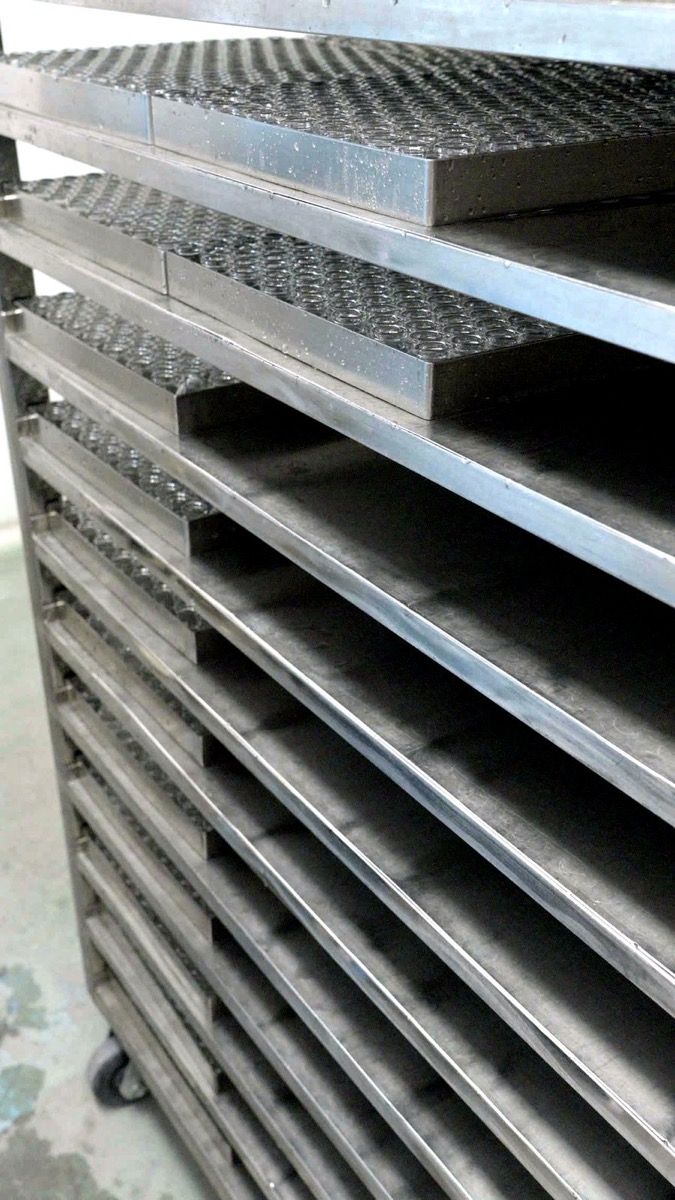
What lyophilization is, and what it leaves behind
Lyophilization (freeze-drying) removes water from a frozen solution by sublimation under vacuum. For peptides it is the standard final step after purification: the purified fractions from preparative HPLC, in aqueous acetonitrile with an acid modifier, are frozen and dried, and the result is a solid in which the peptide is present as a salt with whatever counter-ion the purification left behind, together with a small amount of residual water.
Three properties of the lyophilized form matter for documentation:
- Stability. Chemical degradation (hydrolysis, deamidation, oxidation) and physical change (aggregation) proceed much more slowly in a dry solid than in solution, which is why peptides are stored and shipped lyophilized. Slowly is not never; studies of lyophilized proteins show that aggregation can develop in the solid state during storage, depending on residual moisture and formulation. A retest date on a lyophilized lot's certificate is the manufacturer's statement of how long the figures hold under stated storage.
- Composition. The solid contains peptide, counter-ion and water. Pepti's worked-example records and most research-use certificates report chromatographic purity and identity of the peptide; they do not report water or counter-ion. The purity guide explains why gross weight and peptide weight differ.
- Hygroscopicity. Lyophilized peptides take up atmospheric moisture when opened. A vial that has been opened, weighed and resealed is no longer in its certified state; this matters for anyone who subdivides lots.
The lyophilized vial is the manufacturer's product in its most stable and best-documented form: one lot, one certificate, one retest date, and a QR code or lot label that resolves to the record.
What a pre-mixed vial is
A pre-mixed vial contains the peptide already dissolved. Someone, the manufacturer or an intermediary, has taken lyophilized material, dissolved it in a solvent at a target concentration, filled vials, and closed them. The solvent is usually water with or without a preservative, sometimes with buffer components or co-solvents, depending on the peptide's solubility.
That sentence contains four new variables, none of which exist for the lyophilized product:
- The solvent: its identity, grade and source.
- The concentration: how much peptide per unit volume, which depends on the lyophilized lot's actual content, not its nominal weight.
- The fill volume: how much solution is in each vial.
- The person who did it, and when: the solution is a second manufacturing step with its own lot identity, date and conditions.
A pre-mixed vial therefore has two lots behind it: the lyophilized peptide lot and the solution lot. A certificate that describes only the first has not described the product in the vial. This is the central documentation point of this guide, and it is the question to put to any supplier of solutions: which lot does your certificate describe, and where is the documentation of the solution step?
Stability in solution
Peptides in aqueous solution degrade by routes that are well characterized. A 2023 review in Pharmaceutics summarizes them: hydrolysis of the peptide bond, especially at aspartate residues; deamidation of asparagine and glutamine; oxidation of methionine, cysteine, tryptophan and histidine; isomerization and racemization; and physical instability through aggregation, adsorption to surfaces and precipitation. The rates depend on sequence, pH, temperature, light, oxygen and the presence of metal ions, and the same review notes that pH optimization and the choice of buffer are the most practical stabilizing measures, which is to say that the solution's composition determines its shelf life.
For the reader of documents, the consequences are these:
- A retest date for a lyophilized lot does not transfer to a solution made from it. The solution needs its own stability data, under its own storage conditions, or at minimum a stated use-by period with some basis.
- The certificate's purity figure describes the peptide at the time of testing, in the solid. Once dissolved, purity falls over time at a rate that the certificate cannot predict. A solution tested on the day it was made and a solution tested after three months at room temperature are different samples.
- Preservatives and buffers are additional components whose identity and grade should be stated, and which can themselves interact with the peptide.
- Container-closure matters more. Solutions contact the vial and closure continuously; adsorption of peptide to glass or elastomer reduces the concentration in solution, and leachables can appear. Lyophilized solids are far less affected.
ICH Q1A(R2), the stability-testing text for regulated products, describes the design of studies that establish how long a product holds its specification under defined conditions. No research-use supplier runs studies of that design, but the text is useful as a description of what a stability claim means: tested, under stated conditions, at stated intervals, against a specification. A use-by date on a pre-mixed vial without any of that is an estimate.
Which lot does the certificate describe?
Put the two formats side by side and the documentation gap is visible.
| Document element | Lyophilized vial | Pre-mixed vial |
|---|---|---|
| Lot identity | One lot code, assigned by the manufacturer | Peptide lot code plus a solution lot code (or date) |
| Certificate of analysis | Describes the solid: purity, identity, sometimes content | Should describe both: the peptide lot and the solution as made |
| Content statement | Nominal mass per vial; actual content by assay if measured | Concentration (mass per volume) and fill volume; depends on measured peptide content, not nominal |
| Solvent | Not applicable | Identity, grade, source, any preservative or buffer, with lot |
| Stability or retest | Retest date for the solid under stated storage | Needs a separate use-by or stability statement for the solution |
| Who performed the last step | The manufacturer | The manufacturer, or an intermediary; must be stated |
| Verification by test | Identity, purity, content of the solid | Identity, purity and concentration of the solution, with the date of test relative to the date of preparation |
A supplier of pre-mixed vials that provides only the manufacturer's lyophilized-lot certificate is providing half the documentation. The missing half is a record of the solution step: who made it, when, from which peptide lot, into which solvent, at what target concentration, and with what evidence that the target was met. In regulated manufacturing that record is the batch record and the release testing; 21 CFR 211.166 requires stability testing that supports the expiration dating of the product as it will be supplied. For research-use solutions the standard is lower, but the questions are the same, and a supplier that cannot answer them is asking you to trust an undocumented step.
Verifying each format
Lyophilized. Verification follows the COA guide: match the lot code on the label to the certificate and to any public record, cross-check identifiers against PubChem, and, where warranted, have a vial you selected tested for identity, purity and content. The vial is the manufacturer's product; the test describes it directly.
Pre-mixed. Verification has to cover both steps.
- The peptide lot. Ask for the lyophilized lot's certificate and resolve it at the manufacturer's origin as for any lot. If the solution was made by an intermediary, this certificate comes from the manufacturer and the intermediary should name it.
- The solution step. Ask who prepared the solution, on what date, from which peptide lot, with which solvent (identity, grade, lot), to what target concentration, and how the concentration was confirmed. A measured concentration (by HPLC against a standard) is evidence; a calculated one ("10 mg in 1 mL") assumes the lyophilized vial contained 10 mg of peptide, which, as the purity guide explains, it usually did not exactly.
- The stability basis. Ask what the use-by period is, under what storage, and what it rests on. "Our experience" is an answer; "tested at these intervals" is a better one.
- Independent test of the solution. A laboratory can measure identity, purity and concentration of a solution directly. Record the date of preparation (from the supplier) and the date of test, because the interval is part of the result: a solution that measures well two weeks after preparation says little about the same solution at six months.
- Appearance. A lyophilized cake should look like one; a solution should be clear and free of visible particles. Cloudiness, particulates or color in a solution that was clear when made are signs of aggregation or degradation and are worth photographing before anything else.
The additional effort is not large, but it is additional, and it falls on the buyer unless the supplier has done it and can show it.
What the label itself should carry
The label is the only document that travels with the vial, and the two formats need different labels.
A lyophilized vial's label should carry the product name, the nominal strength, the lot code in the manufacturer's format, the storage condition, and ideally a QR code that resolves to the lot record. That is enough: every other fact about the vial lives in the record the lot code points to. Pepti's public records are reached exactly this way, and the pattern is the one to look for from any manufacturer.
A pre-mixed vial's label has more to carry, because more has been done to the material: the product name; the concentration and the fill volume; the solvent, including any preservative; the peptide lot code and the solution lot code or preparation date; the use-by period and the storage condition; and the identity of whoever prepared the solution. A solution label that shows only a product name and a concentration has left out the facts that would let you trace it, and the omission is usually a sign that the solution step was not documented at all.
In both cases, the label should agree with the certificate character for character. A lyophilized vial whose label strength differs from the certificate, or a solution whose label concentration does not follow from the stated peptide lot and fill, is a discrepancy to resolve before use.
Where responsibility sits
Documentation follows responsibility. With a lyophilized vial, the manufacturer is responsible for the solid up to the retest date under stated storage, and the user is responsible for everything after the seal is broken. With a pre-mixed vial, the supplier has taken on the dissolving step and is responsible for its outcome: the concentration, the solvent, the stability period. A supplier who sells solutions but documents only the solid has accepted the responsibility without recording the work, and in any later dispute the absence of the record will be the problem. The questions in the next section exist to find that out before purchase rather than after.
Questions to ask a supplier of pre-mixed vials
Asked in writing, these distinguish a supplier who has documented the solution step from one who has not:
- Which lyophilized lot was this solution made from, and may I have that lot's certificate?
- Who prepared the solution, where, and on what date?
- What is the solvent, including any preservative or buffer, its grade and its lot?
- What is the target concentration and the fill volume, and how was the concentration confirmed after preparation?
- What is the use-by period, under what storage, and what evidence supports it?
- Was the solution tested after preparation for identity and purity, and may I see the result?
- What is the container and closure, and has peptide adsorption or leaching been considered for this solvent?
A manufacturer that prepares solutions as part of its own process can answer all seven from its records. An intermediary who dissolves purchased material can answer them only if it kept records; many do not.
When each format is the right documentation choice
From a verification standpoint, the lyophilized vial is the simpler object: one lot, one certificate, long stability, direct testability, and a traceable link from label to record. It places the dissolving step, and responsibility for it, with the user.
A pre-mixed vial moves that step to the supplier, which can be appropriate when the supplier is the manufacturer, documents the solution lot as it documents the peptide lot, measures the concentration rather than calculating it, and states a stability basis. It is a poorer choice when the solution is prepared by an intermediary without records, when the certificate offered describes only the solid, or when the use-by period has no stated basis.
The question to settle before choosing is simply whether the supplier's documentation covers the product as supplied. For a lyophilized vial that is one document. For a solution it is two, and the second is the one most often missing.
Checklist: lyophilized and pre-mixed vials
- You know which format you are buying and which lot or lots stand behind it.
- For a lyophilized vial: the lot code on the label matches the certificate and resolves at the manufacturer's origin; the retest date and storage conditions are stated.
- For a pre-mixed vial: the lyophilized peptide lot is identified and its certificate obtained from the manufacturer.
- For a pre-mixed vial: the preparer, date, solvent (with grade and lot), target concentration and fill volume are stated in writing.
- For a pre-mixed vial: the concentration was measured after preparation, not only calculated from nominal weight.
- For a pre-mixed vial: a use-by period and storage condition are stated, with the basis for them.
- Appearance on receipt matches the format: an intact cake or powder; a clear, particle-free solution.
- Independent testing, if done, records the date of preparation as well as the date of test for solutions.
- The supplier's written policy on confirmed quality issues covers the format you bought.
- Any subdivided, opened or reconstituted material is treated as no longer covered by the original certificate.
FAQ
Does the manufacturer's certificate cover a pre-mixed vial made from that lot?
It covers the lyophilized peptide lot at the time of testing. It does not cover the solvent, the concentration, the fill, the date of preparation or the stability of the solution. A pre-mixed vial needs documentation of the solution step in addition to the peptide lot's certificate.
How long does a peptide remain stable in solution?
It depends on the peptide's sequence, the solvent's pH and composition, the temperature, light and the container. The degradation routes are well described in the literature, but the rate for a particular solution is only known if it has been measured. A use-by period on a pre-mixed vial should come with a stated basis; without one, it is an estimate.
Is a concentration stated on a pre-mixed vial a measured value?
Ask. Many are calculated from the nominal weight of the lyophilized vial divided by the solvent volume, which assumes the vial contained exactly its nominal mass of peptide; it usually did not, because of water and counter-ion. A measured concentration, by HPLC against a standard after preparation, is the figure that describes the vial.
Can a laboratory test a pre-mixed vial?
Yes. Identity, purity and concentration can be measured directly on a solution. Record the date the solution was prepared and the date it was tested, because purity in solution declines with time and the interval is part of the result.
Why do lyophilized vials carry a retest date rather than an expiry date?
A retest date is the point after which the manufacturer asks that the material be re-examined before further reliance on the original certificate, rather than a point after which it is declared unusable. It reflects how slowly well-stored lyophilized peptides change. Solutions, which change faster, more often carry a use-by period.
If I dissolve a lyophilized vial myself, is the certificate still valid?
The certificate remains a true description of the lot as tested. It stops describing your solution, whose purity and concentration now depend on your solvent, your technique and the time since preparation. The same logic applies to a supplier's pre-mixed vial, which is why the solution step needs its own record.
References
- Nugrahadi P. P. et al., "Designing Formulation Strategies for Enhanced Stability of Therapeutic Peptides in Aqueous Solutions: A Review", Pharmaceutics (2023), PMC10056213 — degradation pathways of peptides in solution and the formulation variables that govern them.
- Moorthy B. S. et al., "Predicting protein aggregation during storage in lyophilized solids…", Molecular Pharmaceutics (2014), PMC4051254 — aggregation can develop in the lyophilized state during storage, depending on formulation and moisture.
- Sahakijpijarn S. et al., "Formulation Composition and Process Affect Counterion for CSP7 Peptide", Pharmaceutics (2019), PMC6835953 — what lyophilization leaves behind: counter-ions, and how process conditions change them.
- Sikora K. et al., International Journal of Peptide Research and Therapeutics (2018), PMC5918489 — trifluoroacetate in lyophilized synthetic peptides and its exchange.
- ICH Q1A(R2) — Stability Testing of New Drug Substances and Products — what a stability study is: conditions, intervals and specification.
- ICH Q6A — Specifications — specification elements for substances and products, including appearance and assay.
- 21 CFR 211.166 — Stability testing — the regulated-industry requirement that expiration dating rest on stability testing of the product as supplied.
- 21 CFR 211.165 — Testing and release for distribution — release testing of each batch, including a prepared solution as a product in its own right.
- Lot record PEP260819-RT20, Retatrutide 20 mg (lyophilized) — a public lyophilized-lot record showing manufacture, test and retest dates.
- Pepti public COA library — the lyophilized-lot records used as worked examples on this site.
- Ashraf A. R. et al., Journal of Medical Internet Research (2024), PMC11582493 — independent LC-MS analysis of purchased lyophilized samples, with content and purity findings.
Every reference above is a primary or official source that was opened and read when this guide was last reviewed. Dates are in the review log.
Maintained by Pepti, a Guangzhou peptide manufacturer; lot records referenced here are published at peptioem.com/coa. This guide is informational and does not sell or recommend specific vendors. Corrections: contact.